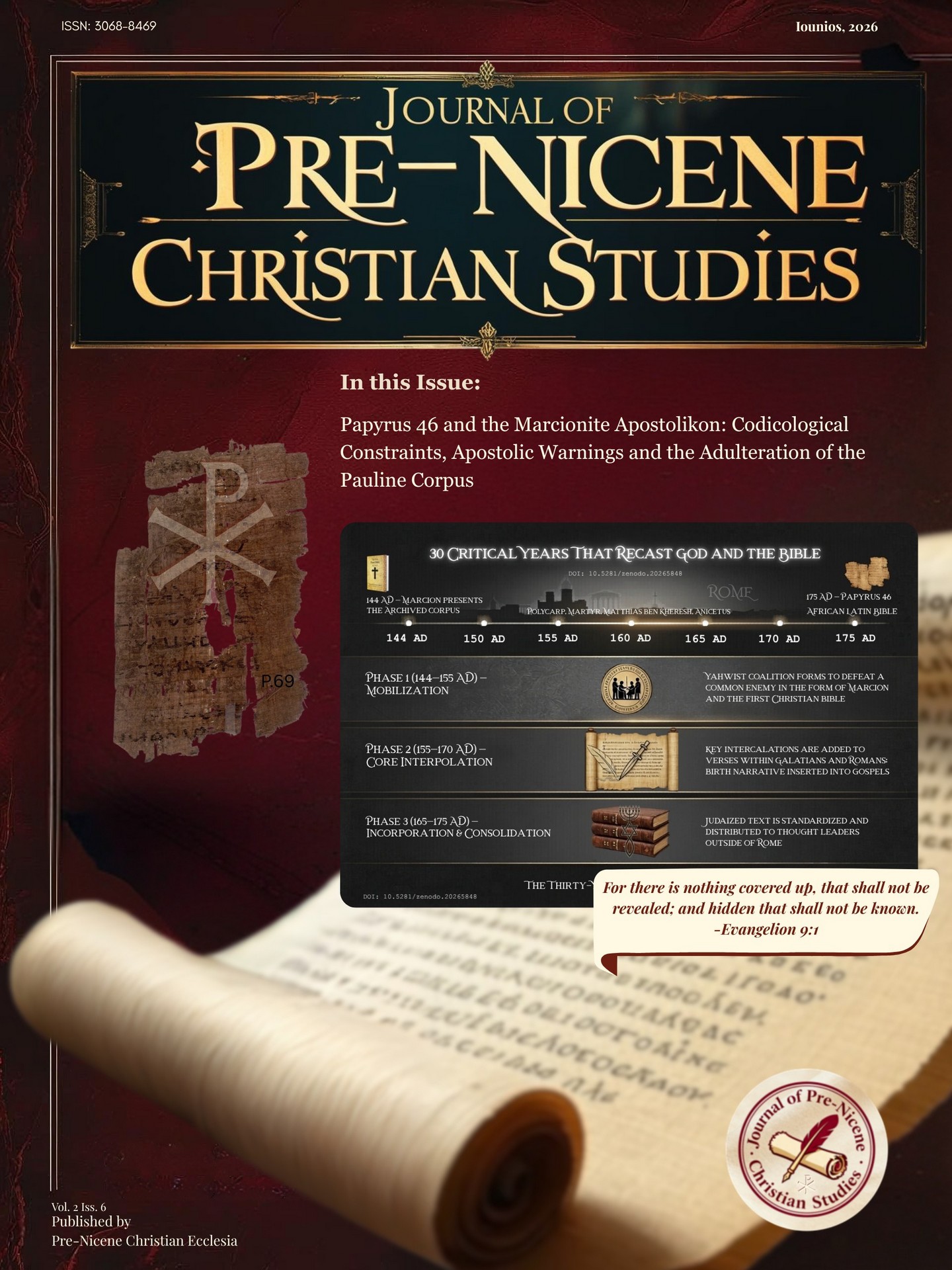
1. Introduction: The Forensic Timeline
The Pauline corpus used by modern churches is a heavily intercalated palimpsest. Its original, recoverable layer is the stratigraphically pure, unalloyed Apostolikon that Marcion of Sinope archived from the Pauline churches and presented to the Roman presbyterium in AD 144. Rather than an editor who altered Paul's words, historical evidence suggests Marcion functioned strictly as an archivist, transcribing and gathering un-tampered letters sitting in situ as they circulated among the communities founded by the apostle.1
At the absolute core of this entire struggle stands an irreconcilable conflict between two competing cosmological frameworks. This divergence is crystallized by the opening line of the Evangelion (1:1):
"In the fifteenth year of Tiberius Caesar, Pontius Pilate being governor of Judea, Jesus descended into Capernaum, a city in Galilee."2
This text features no infancy narrative, no Bethlehem birth, and no Davidic lineage. Jesus emerges directly from a transcendent, un-created, hitherto unknown Father, descending to earth in fully human form in 29 A.D. and immediately begins his ministry. If this introductory, unalloyed framework is accepted, a specific theological trajectory follows: a gospel of uncompromised grace originating from a source completely distinct from the material universe. Conversely, if the infancy narratives and genealogical frameworks found in the expanded, chimerical recension are accepted, the trajectory shifts decisively toward covenantal continuity, validating the authority of the Yahweh deity and the Hebrew scriptures.
The evidence for this structural shift is fundamentally text-forensic. No Christian writer prior to Irenaeus of Lyons (c. AD 180) quotes the crucial covenantal and genealogical links found in Galatians 4:4 ("born of a woman, born under the law") or Romans 1:3 ("descended from David according to the flesh"). This silence encompasses Justin Martyr (d. 165), Polycarp of Smyrna (d. 155), and the entirety of the Apostolic Fathers.
This absolute silence is highly diagnostic. For an apologist like Justin Martyr, who wrote extensive treatises in Rome defending the Davidic lineage of Jesus, the failure to deploy Paul's explicit assertions of physical and legal continuity suggests these verses were not yet present in the primary Roman manuscript type. In fact, Justin Martyr never directly quotes any epistle of Paul by name in his entire surviving catalog (First Apology, Second Apology, and Dialogue with Trypho). If these explicitly high-profile Pauline proof-texts had been available in the Roman archive during his intense mid-century debates, his total failure to deploy them is a catastrophic, unexplained omission.
This structural manipulation cannot be dismissed as a speculative, retroactive conspiracy theory; rather, it represents the industrialized escalation of literary and political vectors explicitly documented by the primary author himself. Within the primitive, unalloyed baseline text of the epistles, Paul repeatedly maps out the specific text-war tactics of his nomistic opponents. In Galatians 2:4, he explicitly identifies the infiltration vector of the competing Judean networks: "And that because of false brethren unawares brought in, who came in privily to spy out our liberty which we have in Christ Jesus, that they might bring us into bondage." More critically, in II Thessalonians 2:2, Paul delivers an urgent warning to his assemblies regarding active literary forgery executed under his own brand: "neither by spirit, nor by word, nor by letter as from us, as that the day of Christ is at hand."
The primitive text itself establishes that stealth intercalation, subversive surveillance, and pseudepigraphal letter-tampering were the established, empirically documented operational weapons of the nomistic movement from its genesis. The Yahwist temple-church alliance in mid-second-century Rome did not invent these mechanics; they merely codified and scaled them into a top-down publishing monopoly once Marcion's unalloyed single-volume archive was delivered into their urban jurisdiction.
The Irenaean Boundary (c. AD 180)
Crucially, when Irenaeus of Lyons finally registers the first unambiguous citations of these phrases in Against Heresies (c. AD 180), his witness sits safely outside the thirty-year window (AD 144-175). Irenaeus should not be viewed as a participant in the active editing room, but rather as the first authorized distributor of the finished Yahwistic temple-church coalition product. Writing from Gaul, his chief objective was establishing a unified, trans-regional chimerical franchise to crush regional variant movements. To achieve this, he required the marketing of the exact same intercalated composite that Rome had spent the previous three decades manufacturing. His sudden deployment of these verses does not disrupt the timeline; it marks its completion and commercial rollout. The chronological bracket for this editorial stabilization is thus anchored by documented textual activity in mid-second-century Rome, culminating in the earliest surviving physical witness of the expanded collection, Papyrus 46 (c. AD 175).3
2. The Context: Overlapping Trajectories in Post-Bar Kokhba Rome
Following the catastrophic defeat of the Bar Kokhba revolt (AD 132-136), the geopolitical and religious landscape of central Italy shifted dramatically. Torah-committed Jewish factions and refugees dispersed, with the imperial capital serving as a natural gathering point for the displaced Judean intelligentsia. By the mid-140s, a robust intellectual network had formed within the broader Roman Jewish and Christian communities.4
When Marcion presented his archived, stratigraphically pure corpus in AD 144, the theological emergency confronting the Yahwist temple-church alliance was not merely an administrative or legal anxiety regarding Roman imperial recognition. Rather, the publication of the un-interpolated, unalloyed Pauline archive struck directly at the structural and cosmological bedrock of their entire religious framework.
The Apostolikon's pristine text-type demonstrated that the gospel of pure grace operated completely independent of the deity Yahweh, the legal codes of the Torah, and the sacrificial machinery of the temple. Had this unalloyed corpus been permitted to stand as the definitive apostolic baseline, the Yahwist temple-church coalition's entire theological economy - anchored in covenantal continuity, prophetic legitimacy, and the cosmic authority of Yahweh - would have faced total obsolescence.
To counter this existential liquidation, the nomistic temple-church coalition capitalized on the highly developed scribal infrastructure and text-critical capacity of the localized post-war Jewish intellectual milieu. By executing a systematic, top-down revision of the Pauline text, they forcefully superimposed an intrusive, alloyed layer of legal and genealogical continuity onto the archive, transforming the unharmonized original corpus into a heavily adulterated, synthetic composite designed to secure their institutional dominance over the early Christian movement.
Post-Bar Kokhba Demographics and the Absence of Urban Violence
This chimerical synthesis was facilitated by a unique, symbiotic non-aggression milieu distinct to the imperial capital. While the messianic violence of the Bar Kokhba crisis in the Levant resulted in the active, documented persecution of variant messianic Christian factions by Torah-compliant nationalist forces, the text-forensic record inside Rome during the thirty-year window (AD 144-175) reveals an absolute absence of physical conflict between the local Jewish academies and the emerging Yahwist temple-church alliance. Marcion and the first Christian bible represented a common enemy to all sects who worshipped Yahweh.
This total lack of urban friction is highly diagnostic. As evidenced by Justin Martyr's Dialogue with Trypho (compiled in Rome c. AD 155), while polemical and rhetorical boundaries remained sharp, there are zero records of physical incursions or systemic violence executed by the Roman synagogue networks against the local presbyterial coalition.
Under the immediate surveillance of the pagan Roman state, both Mattithiah ben Heresh's prominent academy and the nomistic temple-church coalition operated under a shared existential necessity to maintain civic order. This political proximity fostered a literary symbiosis: the Yahwist temple-church network required the highly developed scribal infrastructure and text-critical capacity of the localized Jewish intellectual milieu to execute their comprehensive, multi-volume textual defense against Marcion. In return, this chimerical redaction effectively neutralized the Marcionite threat to the antiquity of the Hebrew scriptures, constructing a massive, alloyed library that would ultimately leave the final canon heavily weighted toward the Torah collection (bibles today are comprised of roughly 75% Torah books with the balance represented by the intercalated text discussed in this paper).
3. Factions and Intellectual Networks in the Roman Milieu
The counter-campaign was sustained across several successive Roman episcopates:
- Pius I (c. AD 140-154), who initiated the formal institutional break with Marcion in AD 144.5 Anicetus (c. AD 154-167) and Eleutherus (c. AD 174-189), who maintained the structural consolidation of the text.
- Polycarp of Smyrna, who provided regional apostolic prestige during his mid-century visit to Rome, famously denouncing Marcionite theology.6
- Justin Martyr (c. AD 100-165), who furnished the philosophical framework necessary to read the Hebrew scriptures as preparatory for Christ, though notably executing this defense without ever citing Paul's epistles.7
- Mattithiah ben Heresh, a prominent tanna who established a recognized yeshiva and academy (beth din) in Rome after fleeing the Hadrianic persecutions. This institution represented a highly developed infrastructure of formal scribal literacy fluent in the textual mechanics of the era.8
- Hegesippus, a converted Jew from Jerusalem whose arrival in Rome coincided with this window. Displaying deep proto-Ebionite leanings, he emphasized a strict episcopal succession list, celebrated the Torah-observant asceticism of James the Just, and championed the unifying formula that "in each succession and in each city all is according to the law, the prophets, and the Lord."9
4. Anatomy of the Thirty Year Campaign (AD 144-175)
The stabilization of the alloyed Pauline composite unfolded as a multi-phase editorial recension compressed into roughly three decades, driven by urgent structural necessity.
Scriptorium Workflow: Redaction Management and Codicological Risk
To reconstruct the physical mechanics of this textual intervention, the thirty-year window must be evaluated not as a series of random copyist errors, but as a highly coordinated scriptorium project management workflow executed by the Yahwist temple-church alliance. The execution of a systematic, top-down revision across a pre-existing corpus demanded two distinct intellectual and operational layers: a redaction manager functioning as the theological architect, and trained scribes executing the calligraphy and page mathematics.
When mapping this desk-level operation, it becomes evident that the insertion of covenantal material into the primitive, un-alloyed Pauline autograph created severe text-forensic risks. The management team had to calculate three interlocking structural disruptions to ensure their newly fabricated additions did not format-crash the surrounding authentic narrative:
- Internal Cross-Reference Contradictions: Wedging pro-Torah harmonizations into the letters threatened to corrupt the surrounding authentic text. For example, introducing the Abrahamic Graft into Galatians 3 required a meticulous, line-by-line audit of the entire letter to ensure the new lines did not clash so violently with Paul's primitive baseline assertions (such as those in Galatians 5) that the text rendered itself unreadable nonsense.
- Calligraphic and Format Seamlessness: A scribe could not simply insert foreign phrases mid-page without disrupting column margins or altering handwriting density. To mask these visual stitch-marks, the Yahwist temple-church alliance abandoned traditional scroll delivery and adopted the single-volume codex format. This format allowed the compilers to reset the page breaks and column lengths across the entire compiled volume, smoothly absorbing the new intercalations into a fresh master layout that obscured the primitive boundary marks.
- Interlocking Corpus Alignment: The editorial team could not alter the Pauline letters in a vacuum; they had to coordinate their edits with the syncretic gospels then circulating in Rome. The insertion of Romans 1:3 ("descended from David according to the flesh") would remain contextually invalid unless local libraries possessed an accompanying gospel genealogy to back it up.
Therefore, the redaction of the Pauline collection operated in lockstep with the stabilization of the Gospels, engineering an entirely integrated, two-part chimerical library designed to overwrite the unharmonized original corpus and validate the historical continuity of the Hebrew scriptures.
Phase 1: Mobilization (AD 144-c. 155)
Following the formal rejection of Marcion's thesis, the leadership of the nomistic temple-church coalition sought to map the scale of the crisis. The urgency was dictated by the explosive growth of the Marcionite churches, which contemporary and later patristic sources acknowledged had spread across the empire.10 Both Epiphanius and Theodoret of Cyrus testify to the vast, independent footprint of Marcionite churches, which directly challenged the institutional authority of the Roman Yahwistic alliance.11
Phase 2: Core Covenantal Harmonization (c. AD 155-170)
To correct the radical dualism of the stratigraphically pure corpus, the compilers introduced targeted, covenantal integrations into the text-type of the core letters:
- Galatians 3:6-9: Grafted Abrahamic covenantal theology directly into Paul's justification discourse.
- Galatians 4:4: Inserted the intrusive stratum "born of a woman, born under the law" to establish an undeniable legal and birth reality for Christ.
- Romans 1:3: Intercalated the phrase "descended from David according to the flesh" to secure Christ's ancestral, prophetic validation.
These surgical edits effectively subordinated the unalloyed revelation of the transcendent Father to the assumed authority of the deity Yahweh.12
Phase 3: Corpus Expansion and Pastoral Integration (c. AD 165-175)
Simultaneously, the editors expanded the architecture of the corpus by incorporating independent, highly structured texts that reinforced ecclesiastical order and Torah continuity. This phase saw the integration of the Epistle to the Hebrews - which provided a detailed, sacrificial typology linking Jesus to the Levitical system - and later, the Pastoral Epistles (Titus and 1 & 2 Timothy).
5. Transmission: Codicological Constraints and Paratextual Subversion in Papyrus 46
The physical manifestation of this completed Roman redaction is first structurally preserved in Papyrus 46 (c. AD 175). Rather than capturing an unengineered, organic evolution of letters, P46 exhibits the precise material and paratextual artifacts of a top-down, institutionally managed recension. The codex presents a unified editorial product: a single-volume collection that absorbs the newly intercalated material into a seamless physical format, masking the primitive boundaries that would have been visible in individual scroll copies.
The codicological constraints of P46 reveal that its compilers were working with a pre-existing textual architecture. The pagination, quire structure, and content ordering all reflect a deliberate editorial program, not the organic accumulation of independently circulating letters. The physical evidence of P46 is thus not merely a witness to the text; it is a witness to the process of textual manipulation itself.
The total absence of pre-Irenaean citations for the specific proof-texts (Galatians 4:4, Romans 1:3), combined with the physical constraints of single-volume codex production, maps a distinct thirty-year window (AD 144-175) in which the unalloyed Pauline corpus was systematically adulterated. Papyrus 46 represents the earliest surviving physical artifact of this completed transformation.
6. Conclusion
The thirty-year window between Marcion's presentation of the Apostolikon (AD 144) and the earliest physical witness of the expanded, intercalated corpus in Papyrus 46 (c. AD 175) represents one of the most consequential editorial campaigns in the history of Western religion. During this period, a Yahwist temple-church alliance, operating in the unique intellectual environment of post-Bar Kokhba Rome, executed a systematic, top-down revision of the Pauline text.
The evidence for this revision is threefold: 1) the total absence of pre-Irenaean citations for the crucial proof-texts; 2) the codicological constraints of Papyrus 46, which reveal a unified editorial product rather than an organic collection; and 3) the apostolic warnings embedded in the primitive text itself, which document the very mechanisms of infiltration and forgery that were subsequently deployed.
The Pauline corpus, as it exists in the canonical New Testament, is therefore a palimpsest: a text overwritten but still legible. The original, unalloyed layer - the Apostolikon - can be recovered. And the forensic evidence of the intercalations proves that the overwriting was deliberate, coordinated, and institutionally motivated.
Notes
1. See Mitchell, "The Theophanic Replacement Protocol," JPCS Vol. 1 Iss. 2 (December 2025), on Marcion's archival function.
2. Evangelion 1:1. Cf. Mitchell, "One Eclipse, Two Earthquakes," JPCS Vol. 2 Iss. 1 (February 2026).
3. On P46 dating, see Comfort & Barrett, The Text of the Earliest New Testament Greek Manuscripts (2001), pp. 203-214.
4. On post-Bar Kokhba demographics, see Smallwood, The Jews under Roman Rule (2001), pp. 463-471.
5. On the dating of Pius I, see Eusebius, Ecclesiastical History 4.7-11.
6. On Polycarp's visit, see Eusebius, Ecclesiastical History 4.14-15; Irenaeus, Against Heresies 3.3.4.
7. Justin Martyr's silence regarding Paul is discussed in Mitchell, "The Palimpsest and Mosaic Plagiarism," JPCS Vol. 2 Iss. 4 (May 2026).
8. On Mattithiah ben Heresh, see Babylonian Talmud, Sanhedrin 32b; Neusner, A History of the Jews in Babylonia (1969).
9. On Hegesippus, see Eusebius, Ecclesiastical History 2.23, 3.32, 4.7-8, 4.22.
10. On Marcionite expansion, see Epiphanius, Panarion 42; Theodoret of Cyrus, Compendium of Heretical Fables 1.24.
11. Ibid.
12. Cf. Mitchell, "The Palimpsest and Mosaic Plagiarism," JPCS Vol. 2 Iss. 4 (May 2026), on the theological function of each intercalation.
Bibliography
Comfort, Philip W. & Barrett, David P. The Text of the Earliest New Testament Greek Manuscripts. Wheaton: Tyndale House, 2001.
Mitchell, A.W. "The Theophanic Replacement Protocol." Journal of Pre-Nicene Christian Studies Vol. 1 Iss. 2 (December 2025).
Mitchell, A.W. "One Eclipse, Two Earthquakes." Journal of Pre-Nicene Christian Studies Vol. 2 Iss. 1 (February 2026).
Mitchell, A.W. "The Palimpsest and Mosaic Plagiarism." Journal of Pre-Nicene Christian Studies Vol. 2 Iss. 4 (May 2026).
Neusner, Jacob. A History of the Jews in Babylonia. Leiden: Brill, 1969.
Smallwood, E. Mary. The Jews under Roman Rule: From Pompey to Diocletian. Leiden: Brill, 2001.